
Most people don't ask the question: "how long does it take to get over a breakup?" during the first week. They ask it a month later. Or three months later. Usually, after realizing they are still thinking about the relationship far more than they expected.
That is when the frustration starts. The relationship is over. There has been enough time to process what happened—or at least it feels like there should have been. Yet memories still show up during work meetings, while driving home, or when trying to fall asleep. A breakup that should feel like the past still feels surprisingly present.
Most people ask this question because they want to know whether their recovery is taking longer than it should. The research suggests there is no single timeline for getting over a breakup, but there are clear patterns. Many people experience meaningful improvement within a few months, while emotional attachment often lasts longer. Understanding those different stages of recovery can make the process feel much less confusing.
What Does It Mean to Be "Over" a Breakup?
Before discussing timelines, it's important to define what recovery actually means. When people say they want to get over a breakup, they are often talking about different things.
Some want to stop feeling sad whenever they think about the relationship. Others want to stop checking a former partner's social media, stop replaying old conversations, or stop comparing every new person they meet to someone from their past.
Psychologists generally separate breakup recovery into three areas:
emotional recovery, which refers to the decline of sadness, loneliness, anger, disappointment, and longing.
cognitive recovery, which refers to how often thoughts about the relationship appear.
attachment recovery, which refers to the gradual weakening of the emotional bond that developed during the relationship.
What the Research Says About Breakup Recovery
There is no exact timeline for getting over a breakup. Recovery depends on factors such as attachment style, relationship investment, and the circumstances surrounding the breakup.
However, research consistently shows that emotional recovery is gradual.
Around 11 Weeks: Most People Report Significant Recovery
One of the most widely cited studies on breakup recovery surveyed 1,404 young adults between the ages of 18 and 25.
Researchers found that 71% of participants reported significant recovery approximately 11 weeks after the breakup. Many also reported positive changes, including greater self-confidence, increased self-awareness, and personal growth.
This finding is often interpreted as "it takes 11 weeks to get over a breakup." A more accurate interpretation is that most participants had reached a point where the breakup no longer felt as emotionally overwhelming as it did in the beginning.
Around Three Months: Emotional Distress Often Returns Near Baseline
A more recent study followed young adults before and after a breakup to examine changes in mental health over time.
Researchers found that:
Depressive symptoms increased after a breakup
Emotional distress was highest shortly after the relationship ended
Symptoms gradually declined over the following months
For many participants, emotional well-being returned close to pre-breakup levels within approximately three months
Taken together, these studies point to a similar conclusion: many people experience meaningful emotional recovery within two to three months of a breakup. The findings suggest that heartbreak is often most intense in the early weeks, followed by a gradual reduction in sadness, distress, and emotional disruption.
Although recovery is rarely complete within this timeframe, many people reach a point where the breakup no longer dominates their daily thoughts and emotions.
Why Recovery Timelines Vary So Much
One of the most frustrating parts of a breakup is comparing your recovery to someone else's. A friend may seem ready to move on after two months, while you are still struggling six months later.
That difference does not necessarily mean you loved your ex more or that you are healing incorrectly. Research suggests that recovery is influenced by several factors that can make one breakup significantly harder to move on from than another.
Attachment Style
Attachment style influences how people respond to romantic loss. Research shows that people with anxious attachment often experience more distress after a breakup and tend to recover more slowly.
Common patterns include:
Replaying the breakup conversation repeatedly
Searching for explanations or hidden meanings
Wondering whether reconciliation is still possible
Checking for signs that the former partner still cares
The challenge is not simply the breakup itself. It is the amount of mental and emotional energy that remains focused on the relationship after it ends.
Who Ended the Relationship
The person who initiates a breakup often starts processing the loss before the relationship officially ends. They may spend weeks or months questioning the relationship and imagining life afterward.
The person who was broken up with usually has to process several losses at once:
The end of the relationship
The loss of future plans
The shock of the decision
Questions about what went wrong
This difference in preparation often makes being broken up with feel more destabilizing and emotionally overwhelming.
Relationship Investment Matters More Than Length
Many people assume that longer relationships automatically take longer to get over. Research suggests that relationship investment may be a more important factor.
A breakup often becomes harder to recover from when the relationship involved:
Living together
Shared finances
Mutual friendships
Family involvement
Long-term plans such as marriage or children
In these situations, the loss affects more than the relationship itself. It can disrupt routines, social connections, future goals, and everyday life. That is why a two-year relationship involving shared responsibilities and future plans can sometimes be harder to recover from than a five-year relationship that remained relatively independent.
Why Staying Connected Can Make Moving On Harder
After a breakup, many people stay connected in small ways. They check social media, revisit old conversations, or ask mutual friends for updates.
The urge to reach out is understandable. Many people hope that one conversation will provide closure, reassurance, or a clearer understanding of where things stand.
In reality, the conversation frequently creates something new to think about. Instead of adjusting to the fact that the relationship has ended, you start analyzing their response, their tone, or what they might be feeling.
How a Breakup Recovery App Can Support Healing
Research suggests that recovery is supported by healthy coping strategies, emotional processing, and reducing behaviors that keep you emotionally attached to a former partner. The challenge is applying those strategies when you're tempted to text your ex or replay the breakup in your head for the hundredth time.
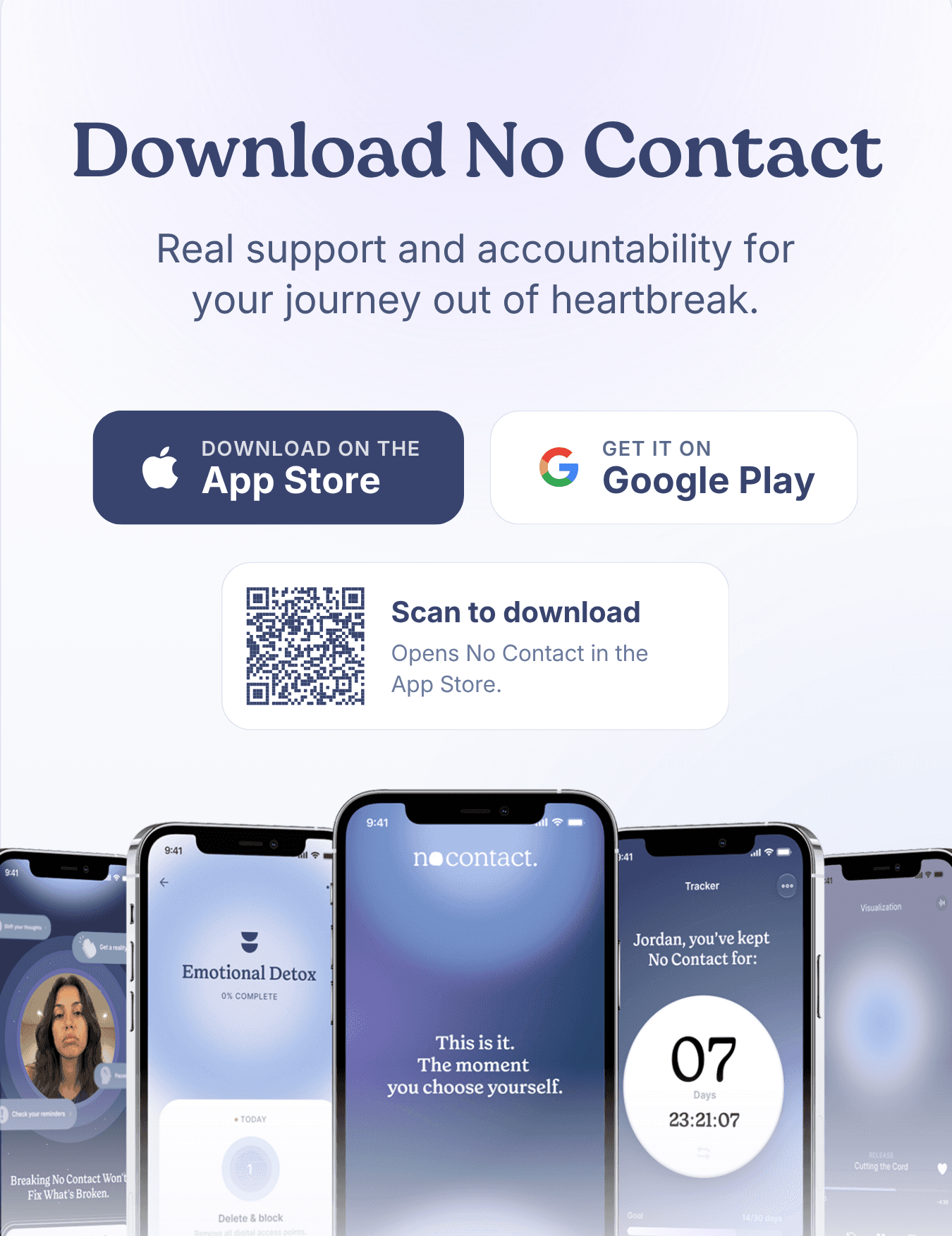
A breakup recovery app can make those moments easier to navigate. The No Contact app combines evidence-based recovery principles with practical tools designed for the everyday challenges of heartbreak.
Build Momentum With No Contact
The No Contact Tracker helps you monitor your streak, complete daily check-ins, and unlock healing milestones. Progress after a breakup often feels invisible, and seeing your consistency over time can reinforce the habits that support recovery.
Interrupt Impulsive Decisions
The Panic Room gives you practical ways to slow down before acting on intense emotions. Instead of reacting in the moment, you can:
Review Reality Check reminders about why the relationship ended
Write unsent messages in the Chat Simulator
Complete Pause & Recenter grounding exercises
Revisit your Evidence Vault
Journal your thoughts privately
Say What You Need to Say—Privately
If you've been asking yourself, "Should I text my ex?", the Write My Ex feature gives you a private space to express your thoughts without reopening contact. It allows you to process difficult emotions without creating new setbacks.
Challenge Unhelpful Thought Patterns
When you're stuck replaying conversations or questioning your decisions, Kai, the app's AI breakup coach, can help you work through those thoughts. Choose Empathy Mode for supportive guidance or Tough Love Mode when you need a more direct perspective.
Keep Nostalgia From Rewriting the Relationship
After a breakup, it's common to remember the highlights while overlooking the reasons the relationship ended. The Evidence Vault lets you save screenshots, journal entries, personal reflections, and red flags so you can return to a more balanced perspective whenever needed.
Invest in Recovery Beyond the Breakup
Recovery doesn't end when the emotional pain starts to fade. The No Contact app provides guided programs and practical resources that support personal growth long after the breakup itself. Whether you're rebuilding your confidence, processing difficult emotions, or working through unhealthy relationship patterns, the app offers tools like Emotional Detox, Self-Love, Healing Insights, and a supportive community to help you continue moving forward at your own pace.
Healing Takes Time (But You Don't Have to Figure It Out All Alone)
Healing after a breakup isn't about reaching a specific deadline. It happens through the choices you make along the way, whether that's resisting the urge to contact your ex, working through difficult emotions, or gradually building a life that no longer revolves around the relationship.
You don't have to navigate those moments on your own. The No Contact app provides practical tools to help you stay focused on your recovery— one day, one decision, and one step at a time.
If you're ready to take that next step, download the No Contact app today.